
It’s no secret that the advertising industry’s preferred model of regulation, self-regulation, has failed. Despite various government inquiries exploring the many flaws in the current system, as well as condemnation from child health professionals and the Australian Medical Association (AMA) the advertising industry has been given free reign to regulate themselves to the detriment of the community, in particular, children.
In 2012, AMA President Dr Steve Hambleton called for a new government inquiry into the sexualisation of children in advertising to protect the health and development of children. He said,
“These are highly sexualised ads that target children, and the advertising industry is getting away with it.
“There is strong evidence that premature sexualisation is likely to be detrimental to child health and development, particularly in the areas of body image and sexual health.
“The current self regulatory approach through the Advertising Standards Bureau is failing to protect children from sexualised advertising.”
We encourage supporters to utilise the complaints process when they come across hyper-sexualised advertising they suspect could be in breach of advertising codes. Many feel understandably frustrated as the ASB continues to dismiss valid complaints while simultaneously claiming that self-regulation is working well and this is evidenced by the fact they rarely uphold complaints! We’ve highlighted some of our previous complaints below to illustrate the great lengths the ASB goes to in order to excuse sexualising and adult sexual content in advertising.

The photo of this billboard was taken from a Brisbane boy’s school. The ASB noted that it is not illegal for the sex industry to advertise outside schools and ruled that this billboard advertising a strip club to children treated sex, sexuality and nudity with sensitivity to the relevant audience (school children) as it did “not show include explicit nudity”.

In response to Schick’s commercial featuring a woman stripping off her clothes to sell men’s razors, the ASB said,”The Board noted that although the woman does remove her clothing…her breasts are covered by text on the screen. It was not sexualised.”
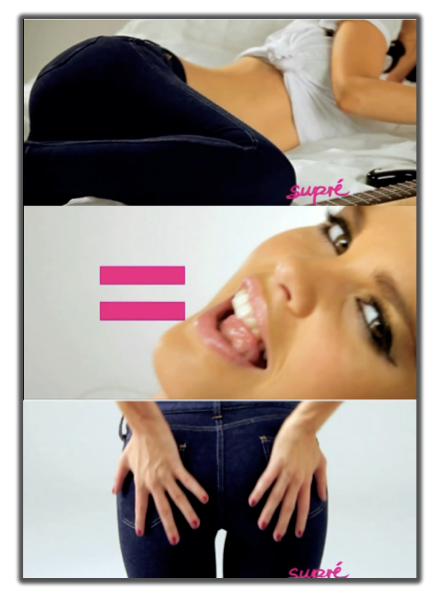
The clothing store popular with teens and pre-teens released this ad to promote their new range of Jeggings. The ASB responded, “The woman was not posed in a sexualised manner.”

It may come as no surprise that this image is part of a larger collection of photos by photographer and accused rapist Terry Richardson, with a reputation for porn-themed photo shoots and for sexually exploiting young models. The ASB said,
“There is no nudity [and] the woman’s pose was not inappropriately sexual.”
“Consumption of this style of lollipop is now common amongst people over 18.”
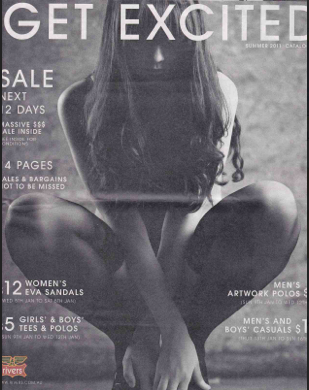
An image of a woman who appeared to be nude aside from thigh high stockings, with her legs apart and her arms covering her private parts was “not overtly sexualised”, said the ASB.
We couldn’t locate a photo of the original poster, however it is the same (life-size) image as shown here on their website.
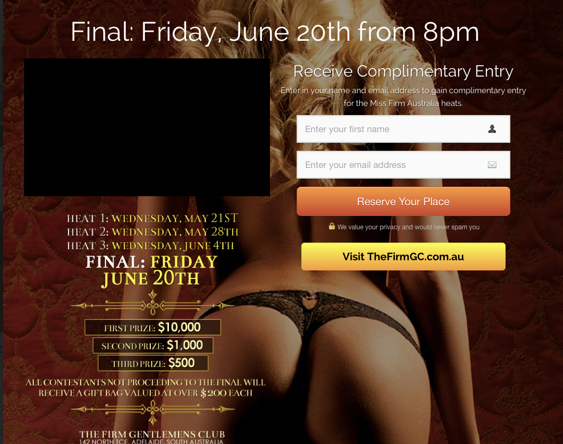
This life size poster was located on a busy Adelaide street. The ASB ruled this outdoor advertising was not in breach of industry codes and standards because “the image is relevant to the advertised product”. The product was women, for men’s sexual use.
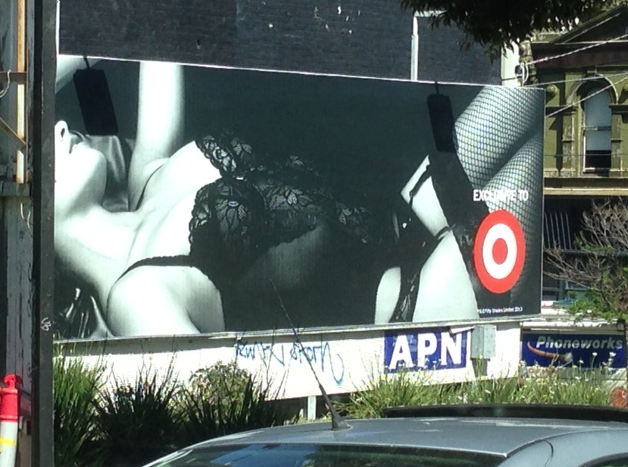
The ASB said the billboard of a faceless woman reclining in lingerie complete with suspenders “[did] not present strongly sexualised imagery and is not inappropriate for viewing by a broad audience including children.”
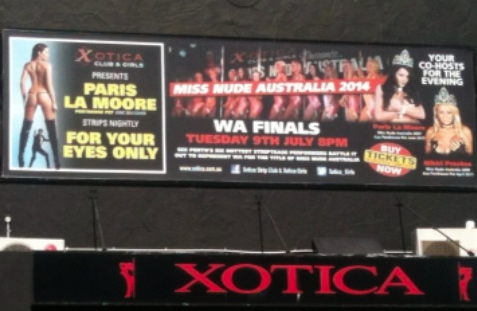
A supporter shared her frustration on encountering this large billboard while taking her children aged four through seven out for lunch. The ASB dismissed complaints about the billboard because the ad “[did] not show any private parts of the woman.” They went on to say:
“In the context of an advertisement for an adult venue the images of the women are not exploitative and degrading.”
“The building which is located in an area which contains a high proportion of adult venues…based on the location of the building, the audience likely to be frequenting the area are generally customers of the venues.”

UltraTune used two dominatrix women brandishing whips and feigning arousal at the sight of tyres and car accessories for the enjoyment of a male staff member to promote their car service centres and accessories. The ASB dismissed complaints, ruling the dominatrix women were “relevant to the product” being advertised.

Perth coffee brand “Fresh One” unleashed a series of porn inspired advertisements on its Facebook page earlier this year. The board upheld complaints against some of the ads, but dismissed complaints against others.
The Ad Standards Board dismissed complaints against this ad featuring a woman pouring milk over her chest.
“The Board noted that the woman is voluntarily pouring the milk over herself.”
“…the image is not exploitative or degrading, with references to ‘bathing in milk’ often associated with luxury (Cleopatra for example) rather than any demeaning activity.”
ASB dismisses complaints against General Pants Pornified “Wet Dreams” ad campaign. Read more here.

The argument that adult, sex industry advertising can be justified in public spaces raises several questions. Do children and young people no longer have a right to be in a public space? Is it permissible for billboards to include sexually explicit content if they are promoting the purchase of women for sex? Do the rights of the sex industry to market itself to the masses take precedence over children’s rights to healthy development?
The Advertising Standards Bureau is a joke. As best-selling author and psychologist Steve Biddulph said, “The UK has an advertising watchdog that actually takes action. Australia has a watch tortoise that might have died.”
It takes a village to raise a child. We often hear from parents who feel overwhelmed and powerless to raise healthy children when the wider culture is undermining their attempts at every turn. Parents need the government and regulatory bodies to do their part in providing a safe environment for children.
The Senate Legal and Constitutional Affairs References Committee, Review of the National Classification Scheme: achieving the right balance (June 2011) recommended that “community concerns about the sexualisation of society, and the objectification of women” be taken into account as a key principle in every classification decision (Recommendation 2). This reflects the core message of Collective Shout that women must never be depicted as mere objects for the sexual satisfaction of men.
The House Standing Committee on Social Policy and Legal Affairs inquiry into the regulation of billboard and outdoor advertising tabled July 4, 2011, recommended a tightening up of the outdoor advertising industry through a more rigorous system of self-regulation. A key recommendation was that objectification of women be seen as a form of discriminatory practice. If the self-regulatory system was found lacking, the committee recommended AG’s impose self-funded co-regulatory system on advertising with government input.
We were particularly supportive of recommendations 4 and 8, which related to issues of objectification of women as forms of discriminatory practice. It is remarkable that in the ASB’s view, as cited in the report, objectification of women was not seen as contrary to the prohibitions on discrimination and vilification.
Clearly the self-regulatory system has been found lacking!
Industry has been warned, has had its chance to voluntarily self-regulate, and has conspicuously failed to act at the level required. The evidence of the past years of minimal response by industry shows that the market culture around this issue will not shift without stronger government initiative.
As published at Collective Shout

3 Responses
The love and rockets billboard was not ‘targeting children’ because this poster was sited conveniently directly opposite a boys school – not a mixed sex school.
So mens’ Sex Industry is targeting and indoctrinating boys as they go to school that women and girls are just males’ disposable dehumanised sexualised commodities. The boys swiftly learn with posters such as the above ones that all women and girls aren’t human.
Why even that precious male created body the ASB believes women and girls aren’t human but merely dehumanised sexualised products advertisers can exploit to increase their profits.
Biddulph is wrong because the Advertising Standards Authority in the UK enacts the same male misogynistic excuses/lies as its brother the ASB in Australia. Both agencies are self-governing which means they are in league with the male dominant advertising industry.
Also both agencies believe ‘indecency’ will not be tolerated but images of naked women faking sexually submissive poses in order to sexually titilate men is fine because no ‘sexualised body parts are on display!’ Forget about the fact men have always dehumanised women and girls and portrayed women and girls as non-human sexualised objects because only what men claim is ‘indecent and offensive to male eyes is important.
This is why we don’t routinely have images of naked men in sexually submissive poses because that would be ‘indecent’ according the ASB and ASA since men’s bodies are not dehumanised sexualised objects.
Making the claim that children are affected by these images is hiding what is really happening and that is mens’ advertising industry is 100% about portraying women and girls as dehumanised sexualised objects whose sole existence is to sexually gratify and please the male gaze. Female children viewing these advertisements are being told this is why females exist – to be males’ disposable sexual service stations. Girls – don’t even think you can achieve your ambitions because these endless misogynistic male created propaganda are telling you ‘your only role is to be a naked dehumanised masturbatory object for male consumption!’
Boys however on viewing these images do not see any naked males but instead only see naked females and this reinforces what boys learn from the Male Supremacist System which is that males are the only humans and males have the right to view females as dehumanised masturbatory objects. After all one can’t inflict harm on an object which isn’t human and this is what boys are learning and enacting.
Without a clear understanding of what these misogynistic and women-hating images are promoting to female and male children, then as usual the issue becomes depoliticised. This is exactly what men demand that there be no real Feminist analysis of this incessant male hatred of women and girls because men do not want to be held accountable for endorsing/justifying/promoting/ignoring this real issue.
I complained about the Ultratune ad when it was shown in early during the state of origin coverage which I was watching with my 11 year old son. I was horrified by the content, but even more so when I received a dismissive ‘this ad has already been considered and found to be fine’ form letter. What recourse is there with such a system where additional complaints hold no weight? Please fix this problem and recognise the objectification of women as an ill that costs our society in many, many ways.
Why is this even happening? Worsening? Women were protesting this in the 70s and it actually got worse. Are we only a marginal voice? Is the majority of women on board with this? Why do we not count? We need a team of radical feminists vandalizing these billboards.
‘Is it permissible for billboards to include sexually explicit content if they are promoting the purchase of women for sex?’ Apparently, the new accepted norm seems to be that there is no problem with promoting the purchase of women for sex. Otherwise, our environment would look quite different.
‘Do the rights of the sex industry to market itself to the masses take precedence over children’s rights to healthy development?’ Considering these children are females, it apparently comes last. More so, healthy development must be compromise if we want more women to be sexually exploited by men. This is the plan, right?
Seriously, I don’t know what to expect for the future. This seems to have no end and just getting worse. Thank you again Melinda and Collective Shouf for your voice and actions. You are the voice of hope.